
Out of Breath, Not Out of Options…
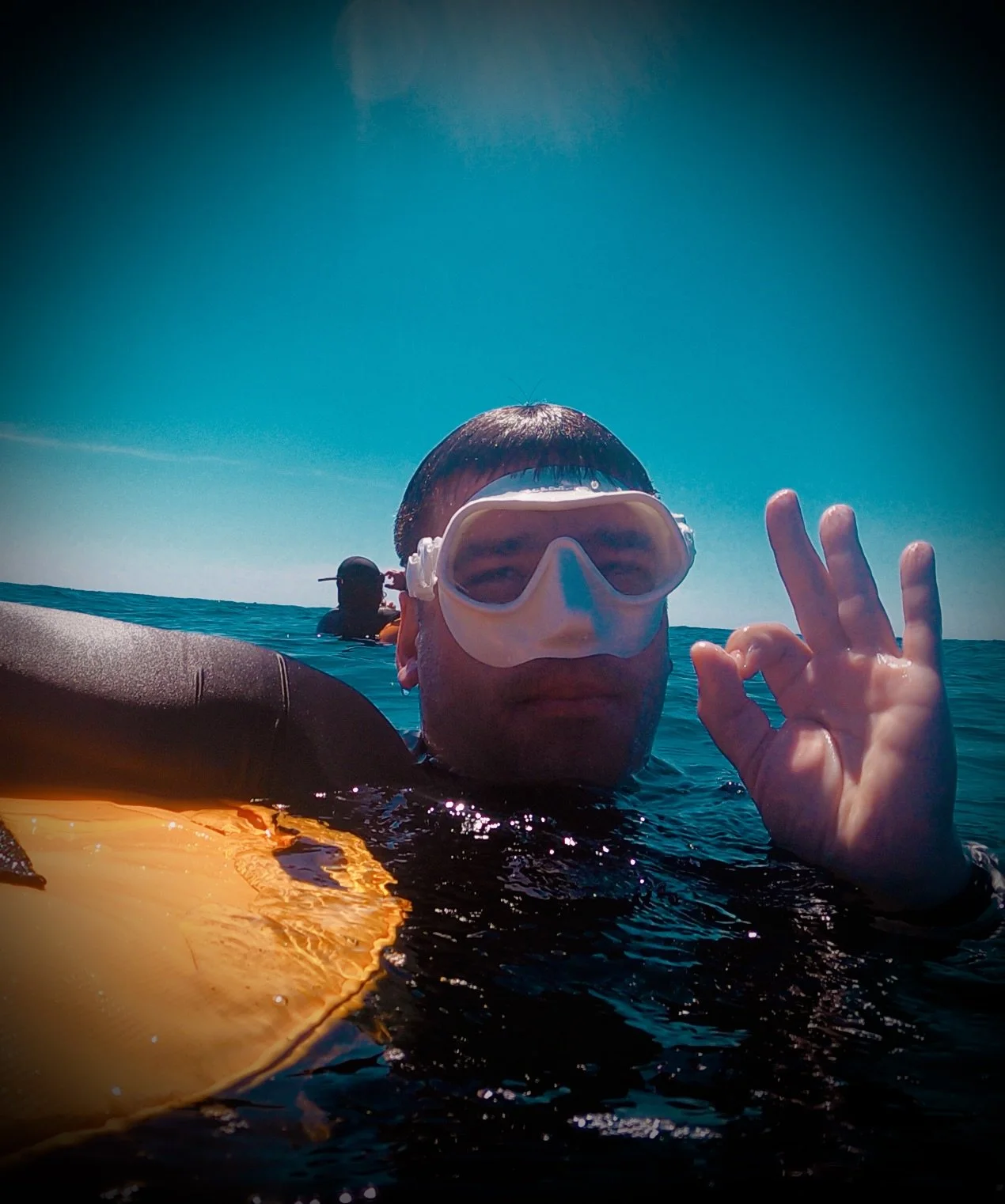
Today I am reflecting on a recent experience during my freediving instructor course. Particularly a moment where I came into contact with a historic and deeply embedded suffering.
The physical requirement of this course has been quite intense. Rather than a schedule where I spend a day in the water and a day out of the water, mindfully exploring the fringes of one’s dive technique, we’re thrust into a configuration where we’re needing to dive repeatedly with limited rest while also remaining attentive not only to ourselves but primarily the diver we’re instructing and caring for.
After nearly a week of this continuously, the fatigue accumulated, and as someone who has been gradually restoring from long term injury and regaining fitness which had been entirely lost, this tested the edge of my capability.
In addition to this there was a threshold in the course where I was completely limited by my capability—I couldn’t actually perform the necessary dive due to being just slightly not fit enough.
My initial feeling was one of dread—that I wouldn’t actually be able to become certified. And to quit was indeed an option (which a particularly pattern of suffering in me was leaning toward). This sense was the beginning of ‘catastrophising’, something much more familiar to me in years gone.
I had reached a point of quite total physical fatigue while faced with limitation, the realisation that I may have no choice in the limitation, and a very strong historical suffering which amounted to feelings of being left out, unable to, or not allowed to participate with the group. It had been a long time since this particular suffering had surfaced, and its familiar ache was strong and real.
Out on the ocean, out of breath, suddenly faced with a separation both from the group and from something I was passionate about undertaking, I became aware of my suffering in a way which I must credit the practise with.
The orientation to the suffering was like this:
Firstly to reflexively notice.
I then recognise that the configuration this suffering wishes to enact is ‘not how I enact things any more’. That was how I first spoke to myself — “this is not how we do things these days, my little suffering”.
There was care in this motion. It wasn’t a reprimand. It was more recognition of the new way, and the comforting of the suffering. Because it’s not simply that ‘we don’t do this any more’, it is that it is not necessary because we have learned that there is another way where the result is known to be positive. And so, my little suffering, “relax with me as we do this a little differently. I know you are there, and you are most welcome. Allow me to show you”.
Then, I noticed I used a reflexive relaxation technique, scanning the body and completely relaxing. This is something I’ve become increasingly proficient with as a freediver. In our Plum Village tradition we have ‘deep’ or ‘total’ relaxation, an hour long body scan where we progressively ease our tensions and deeply relax our bodies. The process is identical in freediving, but we learn to perform this in real time in response to the pressure changes when diving to depth.
And maybe then the most encouraging sensation I noticed was one where I was indeed able to fully relax, despite what the situation was presenting to me.
As such, I recognise that a number of possibilities opened up to me. If I’d enacted the original suffering then I likely would have removed myself from the situation, or allowed the situation to conclude in some way, even when there was another option. Indeed, I was given the choice and asked, “Will, what would you like to do?”. Despite being utterly fatigued, unable to continue in the manner required, and feeling deeply upset at the matter, I was also relaxed and confident enough to explore the other option — which was simply to meet the teaching requirement to a sufficient degree and then dedicate the next weeks to developing the necessary fitness and technique to master this mode.
In all, this experience was a chance to notice a very deep suffering—even under conditions of physical stress, which made the suffering much more acute—and work with it with full confidence, in the manner our teacher, Thay, and the practise teaches us to. I was given the chance to reflect deeply on the many times in the past where my suffering had encouraged me to close off opportunity and potential, contracted and closed to life. And I became so grateful to the conditions which instead allowed life to unfold in the face of the world tightening around me. I’m grateful to Thay, to the practise, and especially to those whom I’ve been practising with, along the path.
A deep bow, dear sangha 🙏🏼 🌱