
‘Arriving and Descending’
A phenomenological inquiry through poetry into freediving
What are we exploring when we freedive?
At first glance, the answer seems obvious.
We are exploring the depths of the ocean.
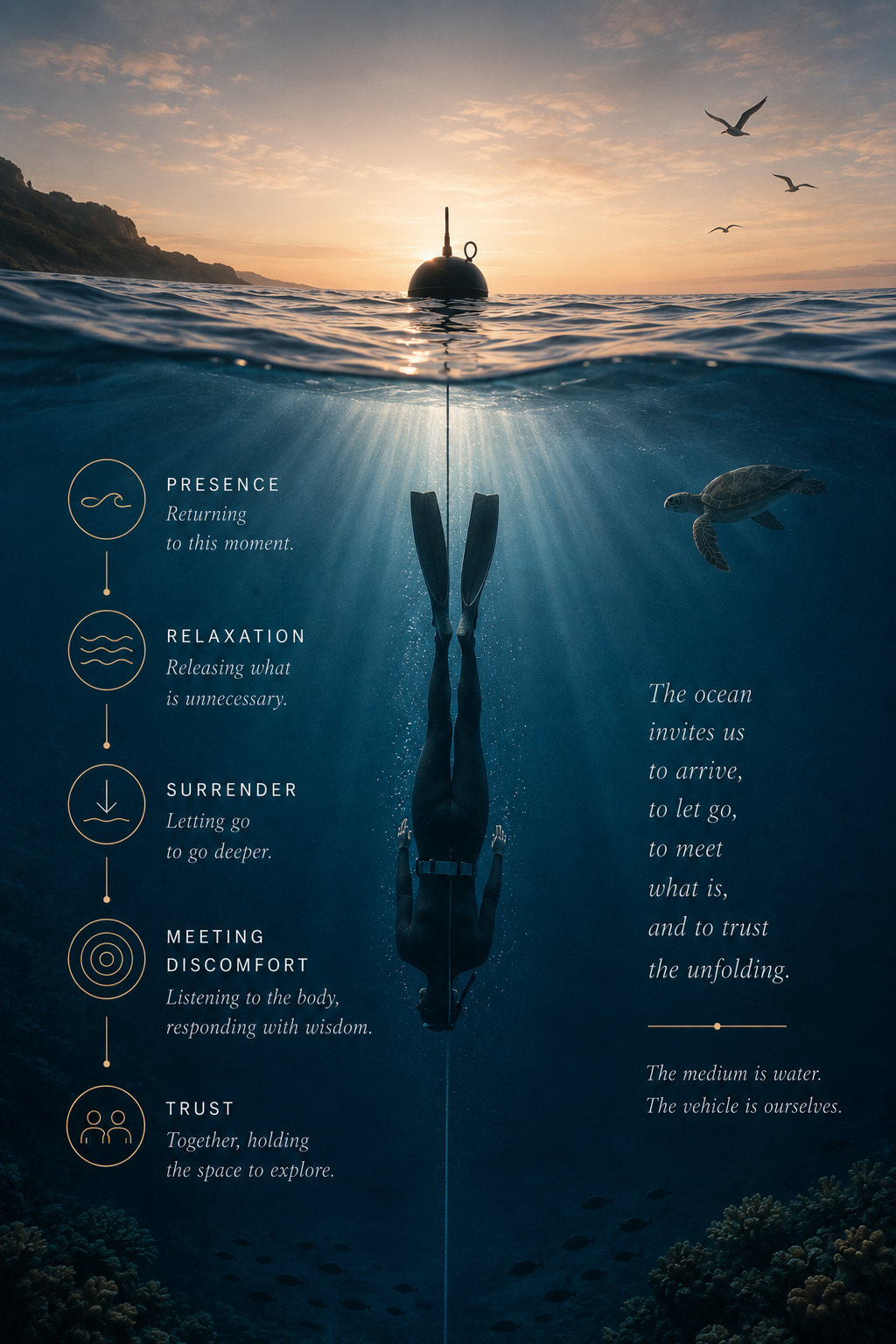
The medium is water.
The vehicle is ourselves.
Yet anyone who has spent time in the water knows that freediving asks something of us.
To descend safely, we learn to become present. We relax. We surrender. We learn to meet discomfort differently. We develop trust—in our bodies, in our training, in our buddies, and in the water itself.
Over the years, as both a freediver and a contemplative practitioner, I began to notice something curious.
These same qualities appear again and again across many contemplative traditions.
Not as abstract ideas, but as practices.
This raised a question for me.
If these qualities allow us to dive deeply into the ocean, what do they allow us to explore in contemplative practice?
The reflections that follow are not an attempt to answer that question. They are simply a record of where the inquiry has taken me so far.
So, what allows us to dive?…
Presence
The water continually returns us to the present moment.
Arriving at the buoy
I stop.
One breath, then another.
In, out,
softer,
and softer yet.
The water lifts me,
then settles me again.
I soften my eyes.
I notice my hand
Too much.
I loosen my grip.
I relax,
again and again,
gentler and gentler.
The body remembers
how to float.
A jellyfish reminds me I am a guest.
A curious turtle tells me I am welcome.
The water moves around me.
my legs are stiff against the water,
So I soften with my breath,
sending relaxation down
down
until they dangle about
with the ocean.
Eyes rest upon the horizon.
Breath,
gentle as the tide.
Not lost
in the desire for depth.
Nor distracted
by thoughts of performance.
Simply here.
Calm.
Present.
Prepared
for what unfolds.
Presence is perhaps the first gift the water offers us.
Freediving does not allow our attention to wander for long. The water keeps bringing us back to the present moment. A hand holding the buoy too tightly. Legs resisting the current. A shoulder carrying tension without us noticing. Again and again, the ocean gently invites us back into the body.
Presence is not something we achieve before the dive begins. It is something we return to, again and again. Each time we notice, we have another chance to soften, adjust, and become more fully present. The dive is no longer something we think about. It becomes something we experience directly through the body.
This was one of the first things that struck me as a contemplative practitioner. The attention developed through freediving felt deeply familiar. Rather than thinking about the dive, I kept being invited back into direct experience. The body stopped being something I was using to reach a goal. Instead, it became the place where the dive was unfolding.
On the line, in the water, we inhabit the body one moment at a time. As we notice, soften, release, and return, something unexpected happens. Thinking becomes quieter, and what remains is simply the dive itself.
A very similar movement appears in the opening instructions of the Ānāpānasati Sutta. Rather than beginning with ideas, the Buddha begins with direct experience:
1. Breathing in a long breath, I know I am breathing in a long breath. Breathing out a long breath, I know I am breathing out a long breath.
2. Breathing in a short breath, I know I am breathing in a short breath. Breathing out a short
breath, I know I am breathing out a short breath.
3. Breathing in, I become aware of my whole body. Breathing out, I become aware of my whole
body.
4. Breathing in, I calm my whole body. Breathing out, I calm my whole body.
The movement is striking. We begin with the breath. Then we become aware of the whole body. Finally, the body begins to relax. Freediving follows the same path. Before the descent, we return to the breath, become aware of the body, and gently let go of unnecessary tension. Presence does not come from thinking more about the dive. It comes from entering more fully into the experience of it.
The similarity is not in what these traditions believe. It is in what they ask us to practise. Both begin with the body, not because the body is the destination, but because it is the ground from which deeper exploration becomes possible. Whether beneath the surface of the ocean or within contemplative practice, presence is not something we create. It is something we keep returning to.
Relaxation
If presence asks where our attention rests, relaxation asks how we relate to our experience.
I lie on the surface,
One hand on the buoy
Ears below the water,
Listen to the deep.
My breath,
gentle and loud
Inside me
I relax
over and over,
Tension flows
Through fingers and toes
Received by the ocean
Into her swell
Swim with me,
I breathe in,
Dive into me,
I breathe out
Be with me,
I notice my whole body
And then silence,
I relax my body.
Sliding back gently,
Down the line
Effort falls from me,
Unwinds from me
This dive unfolds,
So sweet.
Relaxation is not the absence of effort. It is the gradual release of effort that is no longer needed.
Many new freedivers believe that relaxation is something we achieve before the dive begins. Experience soon teaches us otherwise. Relaxation is something we return to throughout the whole dive. During the breathe-up, the descent, and the ascent, we notice tension, soften around it, and let it go. Again and again, the body remembers how to relax.
As this happens, our relationship with the water begins to change. The swell supports us. Buoyancy carries us. We stop trying to move through the water and begin moving with it. The dive becomes quieter, gentler, and more efficient—not because we are doing less, but because we are no longer doing what is unnecessary.
A similar understanding appears in the Yoga Sutras. Patañjali describes a balanced posture as having both sthira (steadiness) and sukha (ease). The aim is not to become limp or passive, but to find a body that is both stable and relaxed. Freediving asks for the same balance. We need enough stability to move well, and enough ease to avoid wasting energy.
The philosopher Maurice Merleau-Ponty offers another helpful way of understanding this. He suggested that we do not simply observe the world from a distance. We know it through our bodies and our relationship with it. Freediving makes this very clear. The body is no longer just something that takes us to depth. It becomes the place where our relationship with the ocean is lived, moment by moment.
Perhaps this is why relaxation feels so different beneath the surface than it does elsewhere. It is more than a way of saving oxygen or improving performance. It changes how we meet the water itself. The ocean is no longer something we push against. It becomes something that supports us. Relaxation is simply our willingness to receive that support.
Surrender
As we descend, the water asks something different of us.
No longer breathing,
I hold
But what comes with me?
Tension.
in my neck,
my legs
Passengers from the surface,
where we brace
Against this
and that
But here below,
I let go
One by one
to these tensions
Ten meters,
Fifteen…
Hello my little tensions,
You are welcome
but not needed here
Twenty meters,
Twenty-five…
And I fall.
Let go, my little tensions
Fall from my finger tips
The ocean will take you,
as she takes me
Down,
down
The water works
On me,
With me.
I let go.
At the surface, we often brace without noticing. We hold tension in the legs, the arms, the neck, jaw, and the hands. These habits are not wrong. They belong to life above the water. But as the dive deepens, they become less and less useful.
Surrender is the gradual discovery of what no longer belongs.
As buoyancy changes, the body begins to sink more easily. Gravity starts to help rather than resist the descent. Movements become smaller. The diver is invited to meet the underwater world on its own terms, rather than carrying the habits of the surface ever deeper.
This is why surrender is not giving up. It is not passive, and it is not careless. The diver remains attentive, skilful, and responsive throughout the dive. What changes is not the quality of attention, but the quality of effort. We stop trying to make the dive happen and begin to take part in what is already unfolding.
Daoism offers a helpful way of understanding this through the idea of wu wei, often translated as effortless action or non-forcing. It does not describe doing nothing. Rather, it points towards acting in harmony with the conditions we find ourselves in. Freediving invites something similar. Instead of forcing the descent, we gradually learn to move with the water, gravity, and the changing buoyancy of our bodies.
Perhaps this is the deeper invitation of surrender. We do not become less ourselves. We become more at home where we are. The tensions that served us at the surface no longer need to follow us into the depths. One by one, they are free to fall away.
The ocean does not ask us to conquer it, nor to submit to it. It simply asks us to become with it.
Meeting Discomfort
The body, too, has something to teach us.
Along the way,
Gently, down
My limits appear,
The ocean reminds me
You’re welcome,
But you cannot stay
I allow my tensions
To fall away
But what remains,
my body calling
In the water,
Here below
Thank you, dear body
For reminding me
To return
where breath continues
I know you,
We’ve done this before
Thank you for your pain,
Your reminder
But it isn’t necessary,
Not yet
We’ve met,
and will again
Softly into the pain,
I discover
a place I have not been before.
Discomfort is part of every freediver’s journey. Sooner or later, every dive reaches a place where the body asks us to return.
It is easy to think of this as something to fight or overcome. But experience suggests another way. The body is not working against us. It is doing exactly what it has evolved to do. Contractions, the urge to breathe, and the growing desire for air are reminders. They tell us something important. The question is not whether we listen, but how we respond.
With training, our relationship with discomfort begins to change. We learn that the first signals are not the limit of what is possible. They are the beginning of a conversation. Instead of reacting immediately, we remain present. We soften. We observe. We discover that we are capable of more than we first believed—not through force, but through familiarity.
Buddhism offers a similar understanding through the teaching of vedanā, often translated as feeling tone. Before we react, there is simply an experience: pleasant, unpleasant, or neutral. Practice invites us to notice that experience without being carried away by it. In doing so, we create space between sensation and response.
Freediving asks for much the same. The discomfort itself is not the problem. Our relationship with it is what matters. We do not ignore the body, nor do we obey its first request without question. We learn to listen carefully, to understand what the body is telling us, and to respond with wisdom rather than fear.
Perhaps this is why meeting discomfort can become one of the most surprising parts of freediving. The body is not an obstacle to be overcome. It is a companion that has been looking after us all along. As trust grows, discomfort loses much of its struggle. It becomes less an enemy than a teacher, gently reminding us where we are and inviting us to discover, with care, where we may still be able to go.
Trust
Every deep dive rests upon relationship.
I’m reminded I am a visitor,
By my body,
By a jellyfish
A turtle tells me I’m welcome,
The familiar ache of CO2
says only for so long.
I relax into these messages,
And explore
I’ve been here before,
Though perhaps this time
a little longer
A friend dives with me,
Looking
As I look upon myself,
Closely
I am not alone,
Relaxation deepens,
Together.
I meet the edge
Of what is known
A little deeper,
A little longer
My body knows,
My buddy knows
I’ve trained for this,
No reason not to trust
The process,
The unfolding.
One of the most beautiful aspects of freediving is that trust is shared. While one diver descends, another remains fully present at the surface. Their attention creates a space in which exploration can take place safely. In this way, trust is not simply an individual quality. It is something created together.
Many contemplative traditions describe practice in a similar way. Although meditation is often experienced inwardly, it has rarely been understood as a solitary path. The Buddha repeatedly spoke of the importance of kalyāṇa-mittatā—spiritual friendship. Wise companions help us see what we cannot always see ourselves. They support our practice, encourage us when we struggle, and gently help us learn from our experience.
Freediving offers a striking parallel. The buddy is present not only during the dive, but afterwards as well. Following an LMC or blackout, one of the most important parts of the learning process is to revisit the dive together. By reflecting on what happened, the diver and buddy develop a deeper understanding of the conditions that led there, making future dives both safer and wiser. In this sense, trust extends beyond safety alone. It becomes an ongoing conversation that supports growth.
Perhaps this is the deepest lesson trust has to offer. Trust is not the absence of uncertainty. It is the willingness to enter uncertainty together. The diver, the buddy, the body, and the ocean each play their part. None can be removed without changing the nature of the dive itself.
In the end, trust is not simply another skill to learn. It is the relationship that allows all the others to unfold.
Conclusion
Let us return to our original question.
If the qualities that allow us to dive deeply into the ocean are also cultivated across contemplative traditions, what do they allow us to descend into there?
I do not think I have answered that question.
What I have discovered is that the water has been a remarkable teacher.
Again and again, it returns us to the present moment. It invites us to release unnecessary effort, to surrender what no longer belongs, to listen carefully to the body, and to trust both ourselves and those who dive beside us.
It is perhaps no surprise that contemplative traditions have discovered many of these same qualities. Whether sitting quietly beneath a tree or descending beneath the surface of the sea, human beings seem to flourish through similar ways of relating—to the body, to experience, to others, and to the world around them.
Perhaps the deepest connection between freediving and contemplative practice is not that they share the same destination.
It is that they cultivate the same way of travelling.
The medium is water.
The vehicle is ourselves.
Where that journey ultimately leads is, I suspect, something each of us must discover firsthand.
References
Bodhi, B. (trans.) 2000, The Connected Discourses of the Buddha: A Translation of the Saṃyutta Nikāya, Wisdom Publications, Somerville, MA.
Laozi 1997, Lao Tzu: Tao Te Ching, trans. U. K. Le Guin, Shambhala Publications, Boston.
Merleau-Ponty, M. 2012, Phenomenology of Perception, trans. D. A. Landes, Routledge, London.
Ñāṇamoli, B. & Bodhi, B. (trans.) 1995, The Middle Length Discourses of the Buddha: A Translation of the Majjhima Nikāya, Wisdom Publications, Boston.
Patañjali 2009, The Yoga Sutras of Patañjali, trans. E. Bryant, North Point Press, New York.
Thích Nhất Hạnh 1996, Breathe, You Are Alive!: The Sutra on the Full Awareness of Breathing, revised edn, Parallax Press, Berkeley, CA.